
The word "telematics" gets thrown around constantly in trucking. Vendors use it, brokers ask about it, and your competitors may already be running it. But if no one has ever explained what it actually means, it's hard to know what you're buying, or what you're missing.
So let's go back to the basics. This guide breaks down what trailer telematics is, the problems it was built to solve, and the capabilities that separate a modern trailer telematics platform from a simple tracker. By the end, you'll have the clarity you need to make a confident decision for your fleet.
What is telematics?
Telematics is technology that collects data from a moving asset, like a truck or trailer, and sends it to you over a wireless connection. Sensors capture what's happening, and a software platform turns that data into information you can act on.
In trucking, telematics generally falls into two categories: tractor telematics and trailer telematics. They sit on opposite ends of the same semi-truck, but they solve very different problems.
Tractor telematics focuses on the truck and the driver. It shares insights about driver behavior, hours of service, fuel use and engine diagnostics. Its main purpose is to improve driver safety and keep fleets ELD compliant.
On the other end of the semi-truck, trailer telematics focuses on the trailer and the cargo inside it. It gives you insights into asset location, load status, cargo condition, door activity, tire pressure, ABS, lights and dwell time. Its purpose is to give you clear visibility into what's happening with every trailer, from every angle, so you can make better decisions for your business.
Here's why that distinction matters: most fleets have far more trailers than tractors. Trailers get dropped at customer docks, parked in yards and swapped between drivers. Your tractor telematics goes wherever the truck goes, which means the moment a trailer is unhooked, it disappears from view. Trailer telematics closes that gap, so you know what's happening with every trailer, whether it's hooked up or not.
The original problem: "Where's my trailer?"
Picture this. A customer needs a pickup today. You have the right trailer in mind, but no one can find it. Was it left at a customer's dock last week? Is it buried in a yard with 100 others? Did it ever come back at all?
That single question is what launched trailer telematics. And without a real solution, fleets are usually stuck with one of three options. Each one costs more than it seems.
1. Manual yard checks. Someone walks the yard with a clipboard, row by row. It can take hours or an entire day, every one of those hours is a labor expense, and the list is out of date the moment the next truck rolls in. It also does nothing for the trailers sitting at customer sites miles away.
2. Basic GPS trackers. A tracker tells you where a trailer is. That's it. You get a dot on a map, and every question that actually drives a decision goes unanswered: Is it loaded or empty? How long has it been sitting? Is the freight still intact? Is it safe to put on the road?
3. Buying or leasing more trailers. When fleets can't see what they have, they assume they need more. So they add capacity to keep up with demand, while dozens of their own trailers sit idle at customer sites, untouched for weeks. It's an expensive band-aid. It inflates capital and leasing costs and still doesn't tell you whether every trailer is accounted for or road-ready.
None of these approaches gives you full visibility. Instead, they slow down operations, burn labor hours and drain capital, all while forcing your team to make high-stakes decisions on partial information. That's the gap trailer telematics was built to close.
Beyond location: what trailer telematics can do for your fleet
Location is just the starting point. A modern trailer telematics platform combines GPS with cargo sensors, in-trailer cameras and trailer health data, so you can see where every trailer is, what's inside it and whether it's ready to hit the road. Here's what that looks like across three key areas.
1. Efficiency and Automation
The biggest payoff is time. Trailer telematics automates the manual work of figuring out what's going on with your trailers, so your team can spend that time running the business instead.
Virtual yard checks. Instead of walking the yard, you log in and see every trailer on site, sorted by how long it's been sitting. You can also see whether each location has the trailers it needs, or too many sitting unused, so you can move them where they're needed before it turns into a customer service problem.
Loaded or empty status. A loaded trailer sitting idle is freight that isn't moving and revenue that isn't being earned. Depending on the load, that idle time can cost hundreds or thousands of dollars a day in detention, missed delivery windows and spoiled goods. Cargo sensors and in-trailer cameras confirm load status remotely, and trailer telematics can also pull loaded status straight from your TMS.
Dwell time and utilization. Trailer telematics dwell reports rank trailers by unit, yard, customer and lane, and group them by how long they've been sitting. If a trailer has been parked at a customer site for three months, you should know about it, and now you will. Trailer telematics utilization reports show what percentage of your fleet actually moved in a given week or month, which tells you whether you really need more trailers or just need to put the ones you own back to work. One fleet used trailer telematics dwell data to release 228 underused trailers and generated $4.3 million in revenue in the process. Another avoided about $250,000 in new trailer purchases, and a third cut dwell time by 17%.
Cube and weight utilization. In-trailer cameras capture the load at every door event, showing how full each trailer really is. Track average fullness by lane and you'll spot trailers running half-empty, consolidate loads and get more revenue from every mile.
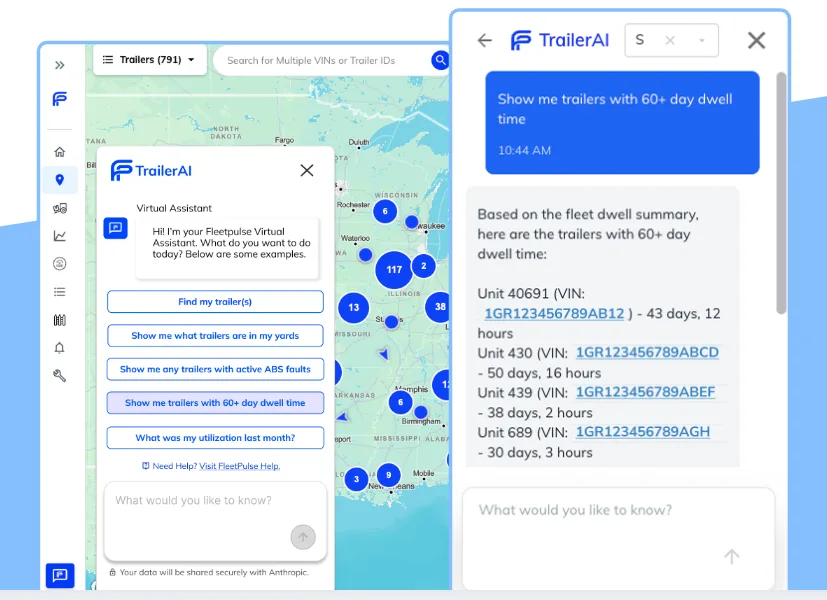
Answers in plain language. Trailer telematics can also let you simply ask questions like "Which trailers have been at this customer for more than 30 days?" and get an answer in seconds. No report builder, no spreadsheet exports.
Works with the tools you already use. Trailer data shouldn't live on an island. An open API connects trailer insights to the systems your team already relies on, so dispatch, maintenance and operations all work from the same picture.
2. Safety and maintenance
Most trailer breakdowns don't come out of nowhere. A slow leak, an ABS fault or a hot wheel end usually gives warning signs long before a trailer ends up on the shoulder. Without trailer telematics, nobody sees those signs, and you find out when a driver calls from the side of the highway. By then you're paying for an emergency road call, a delivery that misses its window and a trailer that's out of service.
Trailer telematics helps you catch issues before your trailers hit the road, so they spend more time moving freight and less time in the repair shop.
Early warning alerts. Sensors monitor tire pressure, tire inflation system activity, wheel-end temperature, ABS faults and light outages. When something drifts out of range, your team gets an alert before it turns into a breakdown or a roadside inspection violation.
Faults that become work orders. Instead of a stream of raw error codes, faults are prioritized and turned into work orders, so maintenance knows exactly which trailers to pull in first and what to fix when they arrive.
Faster roadside response. When a trailer does go down, precise GPS location means your service provider gets there faster, and ABS, tire and light data help them diagnose the problem before they arrive.
Smarter shop management. Set up geofences around your maintenance yards to track how long trailers spend in the shop on average. Combine that with dwell, fault history and path-of-travel data, and you can finally answer questions like: Which trailers are costing us the most? Which ones are sitting idle with cargo still inside? Where have they been?
3. Security and claims
Cargo theft is no longer an occasional risk. It's an organized, high-stakes threat. In the second quarter of 2026 alone, CargoNet recorded 677 supply chain theft incidents across the U.S. and Canada, with estimated losses of $304.6 million. That's more than double the losses from the same period last year, and the average theft was worth over $564,000 (CargoNet).
Thieves are hitting fewer loads but going after much bigger ones. One stolen load can wipe out a quarter's margin and strain a customer relationship you spent years building.
Trailer telematics gives you the speed and the evidence to fight back.
Real-time alerts. Get an instant text alert when a door opens outside an approved location, when cargo shifts or when freight is removed. The moment something looks wrong, you can act, including contacting law enforcement while the trail is still warm.
Faster OS&D claim resolution. When freight arrives short or damaged, OS&D (overage, shortage and damage) claims often come down to your word against someone else's. Timestamped, geotagged cargo images captured at every door event show exactly what the load looked like at pickup, in transit and at delivery. Pair that with historical door open and close logs and dwell history, and claim disputes that once dragged on for weeks can be settled with facts.
Stolen trailer recovery. If a trailer is taken, its live location and path-of-travel history give law enforcement what they need to move quickly, which greatly improves your odds of recovering both the trailer and the freight.
The bottom line: trailer telematics is far more than a dot on a map. It gives you full visibility into every trailer you own, so every decision you make is backed by real data.
Ready to see what your trailers have been telling you?
Every fleet's challenges look a little different, and FleetPulse takes the time to understand yours. We work with more than 200 fleets across North America to turn trailer data into real, everyday wins, from faster yard checks to fewer breakdowns to freight that arrives exactly as it left.
Curious what full visibility could look like for your fleet? Schedule a demo and see it for yourself.
Sources: FleetPulse (platform capabilities and customer results), CargoNet (Q2 2026 supply chain theft data).